

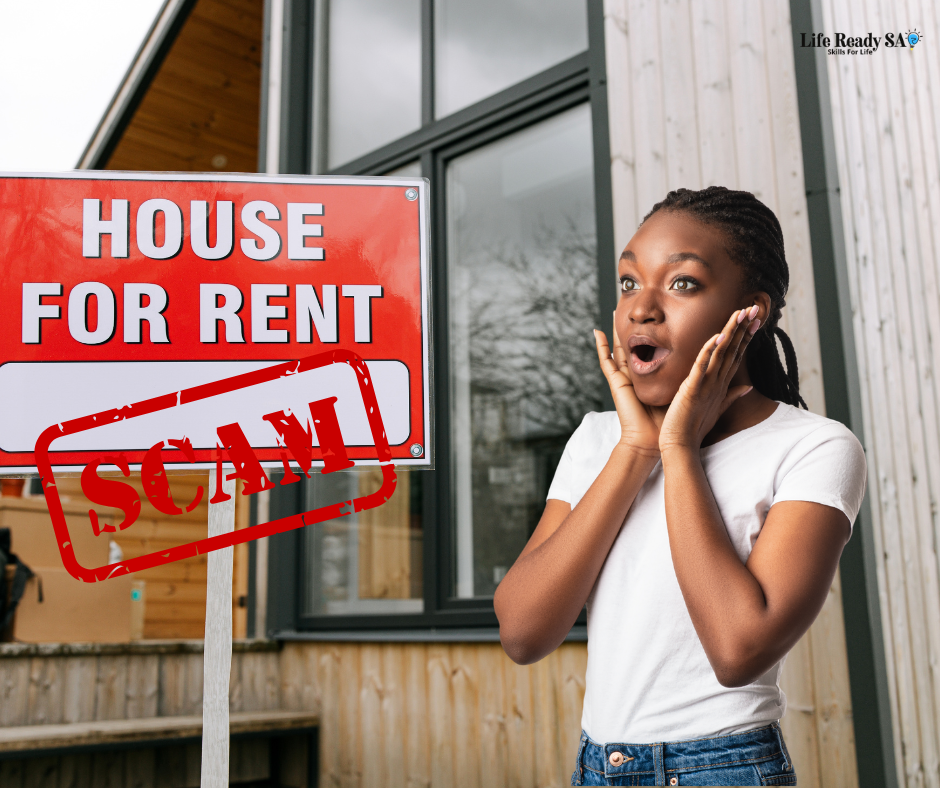
1. The Rental Scam Crisis Hitting SA Right Now
South Africa’s rental market has become a hunting ground for scammers — and they are getting more sophisticated by the day. Whether you’re a first-year student searching for digs near campus, or a young professional looking for your first flat, fraudsters are actively targeting people who are new to the rental process, under time pressure, and unfamiliar with their legal rights.
The tactics are calculated: scammers list properties at below-market prices, create a false sense of urgency, and disappear the moment money changes hands. Victims are left without accommodation and without recourse — often just days before the academic year or a new job begins.
This guide exists to make sure that doesn’t happen to you. Read it before you sign anything. Share it with someone who needs it.
⚠ IMPORTANT: Rental scams are not just a student problem. Anyone entering the rental market for the first time — students, graduates, young professionals, or people relocating — is at risk. This guide covers everyone.
LifeReadySA Tweet
2. Why Students Are Prime Targets
University and college students face a unique combination of vulnerabilities that make them especially attractive to rental scammers:
- Time pressure: Registration deadlines, orientation weeks, and academic calendars create a narrow window to find accommodation. Scammers exploit this urgency ruthlessly.
- First-time renters: Most students have never signed a lease before. They don’t know what a legitimate rental agreement looks like — or what red flags to watch for.
- Remote searching: Students often search for accommodation from their home town before relocating, making it impossible to physically inspect a property before committing.
- Limited funds: Student budgets are tight. A listing that’s R500/month cheaper than everything else looks like a lifeline — and scammers know it.
- Social media reliance: Students frequently find accommodation through Facebook groups, WhatsApp, and Gumtree — platforms with minimal verification and high scam activity.
The result? Thousands of South African students lose their deposits — and sometimes their entire first month’s rent — to scammers every year. Many only discover the fraud when they arrive at the property to find it occupied by someone else, or that the “landlord” has no connection to the property at all.
3. Why Young Adults Are Also at Risk
Rental scams don’t stop at the campus gate. Young adults entering the workforce face many of the same pressures — and a few additional ones:
- Relocating for work: A new job in a different city means finding accommodation quickly, often without local knowledge or a support network in the area.
- Moving out for the first time: The excitement of independence can override caution. Scammers target this emotional state deliberately.
- Online-only searching: Young adults are comfortable transacting online — which is exactly what scammers count on. Digital fluency does not equal scam immunity.
- Trusting professional-looking listings: Modern scammers create convincing fake listings with stolen photos, fabricated agent profiles, and polished communication. They look legitimate.
Whether you’re 19 or 29, if you’re renting for the first time or moving to a new area, the same rules apply. The red flags are the same. The protection strategies are the same. And the consequences of ignoring them are equally devastating.
4. The 5 Biggest Rental Scam Red Flags
These are the warning signs that should stop you in your tracks. If you encounter even one of these, proceed with extreme caution. If you encounter two or more, walk away.
🚩 Red Flag #1: Deposit Required Before Viewing
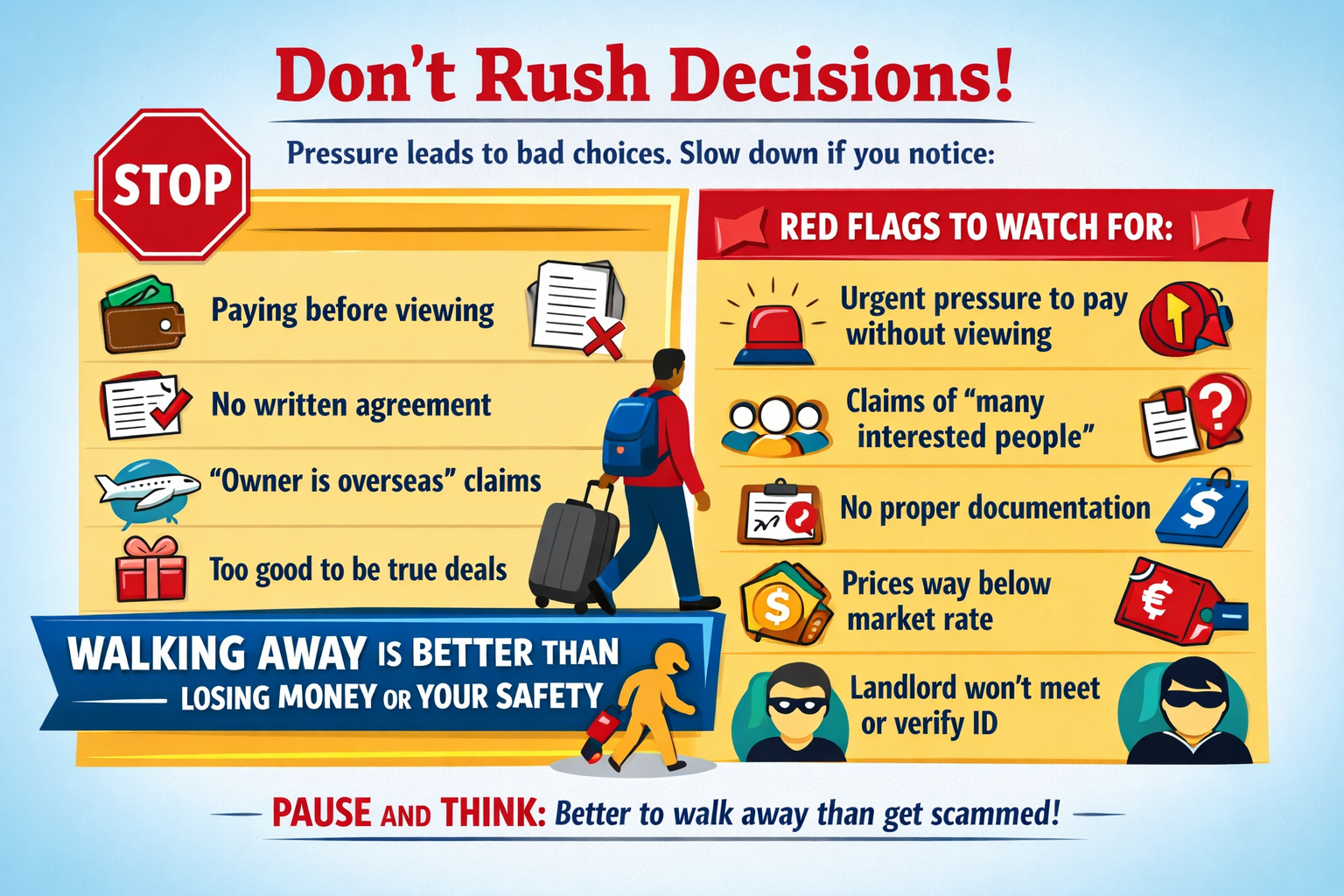
A legitimate landlord will always allow you to view a property before paying anything. If someone asks for a deposit, “holding fee,” or any payment before you’ve physically seen the property — or before a video call viewing at minimum — this is a major warning sign.
Common excuses scammers use:
- “I’m currently overseas and can’t show the property in person.”
- “I’ll send you the keys once the deposit clears.”
- “The property manager will let you in after payment.”
None of these are acceptable. No viewing = no payment. Full stop.
🚩 Red Flag #2: "Pay Now or Lose It" Pressure Tactics
Scammers create artificial urgency to prevent you from thinking clearly or doing due diligence. Phrases like “I have three other people interested,” “the offer expires tonight,” or “I need the deposit by end of day” are designed to make you panic and act without thinking.
A genuine landlord understands that renting is a significant financial and personal decision. They will give you reasonable time to review the lease, verify their identity, and inspect the property. Anyone who won’t give you that time is not someone you want to rent from — scammer or not.
🚩 Red Flag #3: No Written Lease Agreement
In South Africa, a written lease agreement is not just good practice — it is your legal protection. Under the Rental Housing Act, both landlord and tenant have rights and obligations that are only enforceable when documented in writing.
If a “landlord” is reluctant to provide a written lease, offers only a verbal agreement, or sends you a document that looks unofficial or incomplete, treat this as a serious red flag. Without a written lease, you have no legal recourse if things go wrong.
What a legitimate lease should include:
- Full names and ID numbers of both landlord and tenant
- Full property address and description
- Monthly rental amount and payment due date
- Deposit amount and conditions for its return
- Lease start and end dates
- Responsibilities for utilities, maintenance, and repairs
🚩 Red Flag #4: Cash Only — No Paper Trail
Any landlord who insists on cash payments — for the deposit, first month’s rent, or ongoing payments — is either running a scam or operating outside the law. Legitimate landlords accept EFT payments to a verifiable bank account, which creates a paper trail that protects both parties.
Cash payments cannot be traced, cannot be reversed, and provide no proof of payment. If you pay cash and the landlord disappears, you have nothing. Always pay by EFT and keep every proof of payment.
🚩 Red Flag #5: Price Too Good to Be True
Scammers deliberately price properties well below market value to attract desperate renters quickly. If a fully furnished two-bedroom flat near a major university is listed at R3,500/month when comparable properties go for R7,000–R9,000, ask yourself why.
Before engaging with any listing, spend 15 minutes researching average rental prices in that area on Property24, Private Property, or similar platforms. If the listing is more than 20–30% below market rate, treat it as suspicious until proven otherwise.
5. How Rental Scams Actually Work: A Typical Scenario
Understanding the mechanics of a rental scam helps you recognise it in real time. Here’s how a typical scam unfolds:
- The listing appears: A property is advertised on Gumtree, Facebook Marketplace, or a WhatsApp group. The photos are professional (often stolen from legitimate listings). The price is attractive. The description is detailed and convincing.
- Initial contact: You message the “landlord.” They respond quickly and professionally. They may claim to be a property manager, estate agent, or overseas owner. They seem legitimate.
- Urgency is introduced: “There’s a lot of interest in this property. I need to know by tomorrow.” You feel the pressure. You don’t want to lose it.
- Viewing is blocked: When you ask to view the property, there’s always a reason it’s not possible right now. They offer photos, a video call, or promise you can view “after the deposit clears.”
- Payment is requested: A deposit and/or first month’s rent is requested — often via cash, cryptocurrency, or an unfamiliar payment platform. Sometimes a fake lease is sent to make it look official.
- Disappearance: Once payment is made, the “landlord” becomes unreachable. The phone number is disconnected. The email bounces. The listing disappears. You have no property and no money.
Recognising this pattern is your first line of defence. At any point in this sequence, you have the power to stop and walk away.
6. Your Pre-Signing Checklist
Before you sign any lease or hand over any money, work through this checklist. Every single item matters.
✓ | Checklist Item |
☐ | I have physically viewed the property (or done a live video walkthrough) |
☐ | I have verified the landlord’s identity (ID document or business registration) |
☐ | I have confirmed the landlord legally owns or manages the property (title deed or mandate) |
☐ | I have received a written lease agreement that I have read in full |
☐ | The lease includes all required details (names, address, amounts, dates, conditions) |
☐ | I have not been pressured to sign or pay immediately |
☐ | Payment will be made by EFT to a verified bank account — not cash |
☐ | I have researched average rental prices in the area and this listing is in range |
☐ | I have a signed receipt or proof of deposit payment |
☐ | I have a copy of the signed lease for my own records |
☐ | I know the landlord’s full contact details and physical address |
☐ | I have done a basic online search of the landlord’s name and the property address |
7. What to Do If You've Been Scammed
If you believe you’ve fallen victim to a rental scam, act immediately. Time is critical.
- Stop all further payments immediately. Do not send any additional money, regardless of what the scammer tells you.
- Contact your bank. If you paid by EFT, call your bank’s fraud line immediately. In some cases, a recall of funds is possible if acted upon quickly.
- Report to the South African Police Service (SAPS). Open a case at your nearest police station. Bring all evidence: screenshots, emails, payment receipts, and any documents received.
- Report to the platform. If the scam originated on Gumtree, Facebook, or another platform, report the listing and the user account. This helps protect others.
- Contact the Rental Housing Tribunal. Each province has a Rental Housing Tribunal that handles disputes between landlords and tenants. They can provide guidance even in scam situations.
- Warn others. Share your experience in the same groups or platforms where you found the listing. Your warning could save someone else from the same fate.
Being scammed is not a reflection of your intelligence. These fraudsters are professionals. What matters is how quickly you respond.
8. Want to Go Deeper? This Is What LifeReady SA Members Get (COMING SOON)
This blog post gives you the awareness you need to spot a scam before it happens. But awareness is just the starting point.
The real questions come after the red flags: What exactly does a legitimate lease look like? What are your rights if a landlord withholds your deposit? How do you budget for your first place when you’ve never done it before? What do you do when a financial emergency hits and you have no safety net?
These are the questions that LifeReady SA membership is built to answer — with practical, South African-specific content that covers the financial life skills nobody teaches you in school.
As a LifeReady SA member, you get access to in-depth guides, toolkits, and resources covering:
- The full rental rights guide — your rights under the Rental Housing Act, explained in plain language
- Lease agreement toolkit — what to look for, what to negotiate, and what to refuse to sign
- Scam protection resources — not just rental scams, but job scams, banking fraud, and online cons targeting young South Africans
- Budgeting for your first place — deposit planning, monthly expense tracking, and building an emergency fund from scratch
- Financial emergency playbook — step-by-step guidance for when things go wrong
- Consumer rights in South Africa — how to use the CPA, NCA, and other protections that exist for you
This is the content we’re building — and it’s designed for exactly the situation you’re in right now.
9. Final Word: Knowledge Is Your Best Protection
South Africa’s rental market can be navigated safely — but only if you know what to look for. The scammers are counting on your urgency, your inexperience, and your trust. The best thing you can do is slow down, ask questions, and refuse to be rushed.
Remember the five red flags:
- Deposit required before viewing
- “Pay now or lose it” pressure
- No written lease agreement
- Cash only — no paper trail
- Price too good to be true
If something feels wrong, it probably is. Trust your instincts. Do your research. And share this guide with every student and young adult you know who is about to enter the rental market.
LifeReady SA exists to give every South African the financial life skills they were never taught in school. The knowledge in this guide is free — because everyone deserves access to it. The deeper resources, toolkits, and ongoing content are what membership is for.
→ Explore membership at lifereadysa.org.za.
Share this post with a student or young adult who needs to see it.